ABOUT
I'm a didgeridoo player, facilitator and the person behind Primal Resonance.
My work centres around the didgeridoo — performing, teaching, running workshops and exploring what can happen when people make and experience sound together. I play in a contemporary style, drawing on rhythm, improvisation and the extraordinary range of sounds that can come from such a simple instrument.
Primal Resonance has grown out of that. It's where my performances, workshops, collaborations and other explorations of sound come together.

HOW I GOT HERE

My first encounter with the didgeridoo was on Glastonbury Tor when I was about seven. I remember hearing it before I really understood what I was looking at. Someone was playing and a crowd had gathered around him. The sound was low, physical and unlike anything I knew. I can still remember looking at my parents and realising they were just as captivated by it as I was.
Years later, I spotted a bamboo didgeridoo in a shop and that memory came straight back. I bought it for about £15, took it home and assumed I'd work out how to play it. I did not. It made a fairly pathetic noise, circular breathing seemed impossible, and eventually the didgeridoo went behind my wardrobe.
A few years later I heard someone busking with one in town. Again, I heard the sound before anything else. This time I retrieved the didgeridoo and decided I was actually going to learn.
Progress was slow. I practised most days, spent months trying to circular breathe, found a teacher and gradually became slightly obsessed. Through lessons, gatherings, festivals and other players, something I'd mostly done alone became part of a much bigger community.
Years after first hearing the instrument on Glastonbury Tor, I returned with my own didgeridoo and played there.
MY APPROACH
Tradition matters. So does exploration.
The didgeridoo comes from the Aboriginal peoples of northern Australia, with forms of the instrument including the yidaki and mago belonging to living cultural traditions that extend far beyond the way the instrument is often encountered in the West. I think that deserves more than a passing acknowledgement. I'm not an Aboriginal traditional player, and I don't present myself as one.
My own playing sits firmly within the contemporary didgeridoo world. What fascinates me is the sheer range of sound and rhythm that can emerge from such a simple acoustic principle. Small changes in the tongue, cheeks, throat, diaphragm and breath can completely alter the sound.
I particularly enjoy improvisation and collaboration. Some performances have a structure; others leave considerably more room for discovery. I'm less interested in reproducing something note-for-note than in listening and responding to the musicians, the audience and the space I'm playing in.
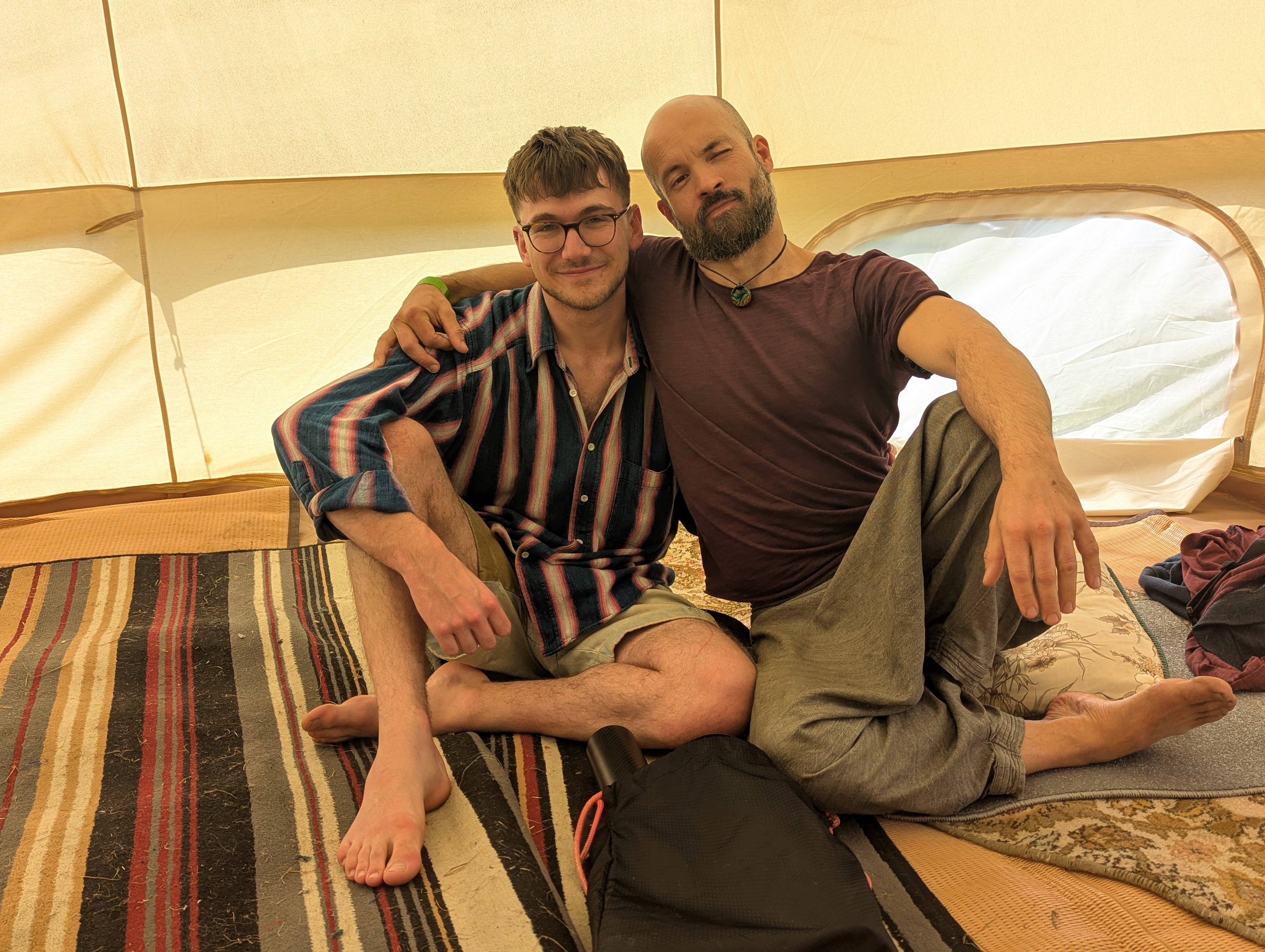
With contemporary didgeridoo player Dubravko Lapaine.
TEACHING & COMMUNITY
I want people to experience it for themselves.

EXPLORING SOUND
Beyond performance
Playing at festivals and gatherings led to another side of my work. I began experimenting with playing around and over people while they lay down, using the vibration and harmonics of the didgeridoo to create immersive sound experiences.
The responses surprised me. Some people became deeply relaxed; others described vivid or emotional experiences. That made me curious about what was actually happening, rather than wanting to make grand claims about it.
That curiosity has led me into breathwork, meditation, somatic practices and therapeutic approaches to sound. I'm now undertaking professional training in group sound therapy with the British Academy of Sound Therapy.
I'm still learning, and I expect I always will be. What interests me is the meeting point between music, listening, vibration, breath and human experience — and how those things can be explored thoughtfully and responsibly.

Interested in working together?
I perform at festivals and events, run didgeridoo workshops and sound-based experiences, and collaborate with musicians, facilitators, artists and organisations.
If you’re interested in booking me, coming to an event, joining a workshop or exploring a collaboration, I’d love to hear from you.